
CASE.EDU:    HOME | DIRECTORIES | SEARCH
case western reserve university

High Energy Astrophysics


Welcome to High Energy Astrophysics

This is the home page of the Experimental High Energy Astrophysics Group at the Physics Department at Case Western Reserve University


What we do


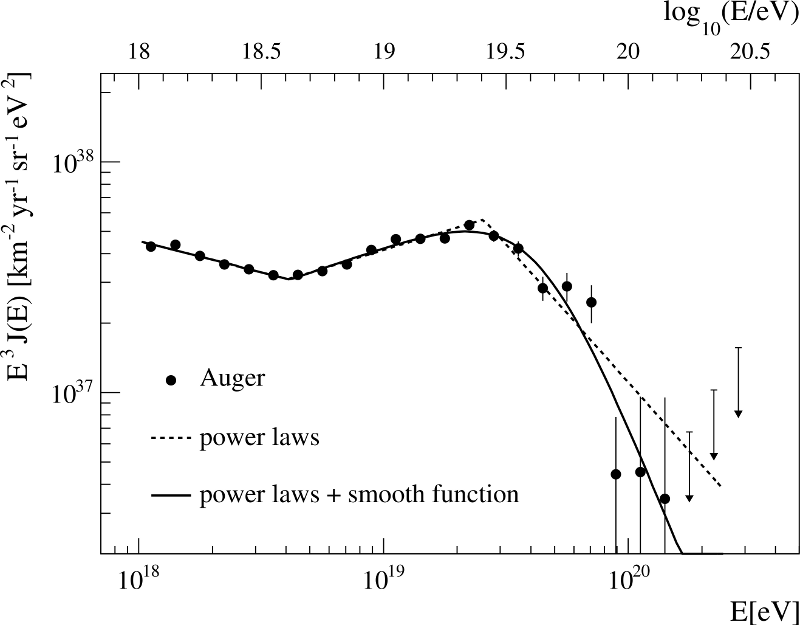
The major activity of the HEA group at CWRU is experimental astrophysics research on the Pierre Auger Cosmic Ray Observatory. Auger is a collaboration of scientists from 17 different countries that have come together to construct the world's largest cosmic ray detector in Argentina. Our scientific goal is to understand the nature and the origins of cosmic rays. To learn more, visit the Auger page at CWRU

Recently, we've begun collaborating with Cyrus Taylor (Physics Department, Dean of Arts and Sciences, CWRU) as part of the Total Cross Section, Elastic Scattering and Diffraction Dissociation at the LHC experiment. The science goals of this LHC experiment would have implications for cosmic ray physics and thus are complementary to our work on Auger. Learn more by visiting our TOTEM page.

Additionally, members of our group are involved in other smaller research efforts: The X-ray Occulting Steerable Satellite ( XOSS ) and an exploration of the potential for the application of large heliostat mirror arrays to the search for extra-terrestrial intelligence ( OSETI ). Historically, we played an important role in the Solar Tower Atmospheric Cherenkov Effect Experiment ( STACEE ) as well.

If you are interested in research on any of these experiments, or in the activities of our group as a whole, please check out the links on this page.

-- Corbin Covault , Associate Professor, Department of Physics, Case Western Reserve University


Research Highlights

November 8, 2007: The Pierre Auger Observatory reports on arrival directions of highest energy cosmic rays.

  • Here is the general press release document (coordinated out of Fermilab)

  • Here is a draft version of a local release by Susan Griffiths in the CWRU communications department.

  • If you want to read the actual paper in the Nov 9 version of Science click here.

  • More information: Contact Corbin Covault, Physics Department, Case Western Reserve Unversity. Phone: 216-368-4006, Mobile: 216-496-2077, email: corbin.covault@cwru.edu

  • Title and Abstract (Science Magazine, Science, vol.318, p.939-943 (9 November 2007):

    Correlation of the highest energy cosmic rays with nearby extragalactic objects

    by The Pierre Auger Collaboration

    Using data collected at the Pierre Auger Observatory during the past 3.7 years, we demonstrate that there is a correlation between the arrival directions of cosmic rays with energy above ~6 x 10^{19} eV and the positions of active galactic nuclei (AGN) lying within ~75 Mpc. We reject the hypothesis of an isotropic distribution of these cosmic rays at over 99% confidence level from a prescribed a priori test. The correlation we observe is compatible with the hypothesis that the highest energy particles originate from nearby extragalactic sources whose flux has not been significantly reduced by interaction with the cosmic background radiation. AGN or objects having a similar spatial distribution are possible sources.

  •  


    This research is supported in part by a grant from the National Science Foundation